Whereas Ukraine is slightly moving away from the feed-in tariff support scheme for renewable energy projects to an auction-based tariff system and seeking alternative market solutions for financing and incentivising the renewable energy projects, the European Union has recently come up with a new renewable energy financing mechanism (the “REFM”), which pushes EU countries to cooperate in investing, building and operating new renewable energy power plants in a cost-effective way.
Overview of the REFM
On 15 September 2020, as part of the Clean Energy Package the European Commission adopted the Regulation on the Union renewable energy financing mechanism (EU) 2020/1294 (the “Regulation”). The Regulation aims to incentivise EU countries to cooperate by making joint efforts in both financing and hosting renewable energy projects. It is expected that such cooperation will lead to an increase of up to 32% of the share of renewable energy in EU gross final electricity consumption by 2030.
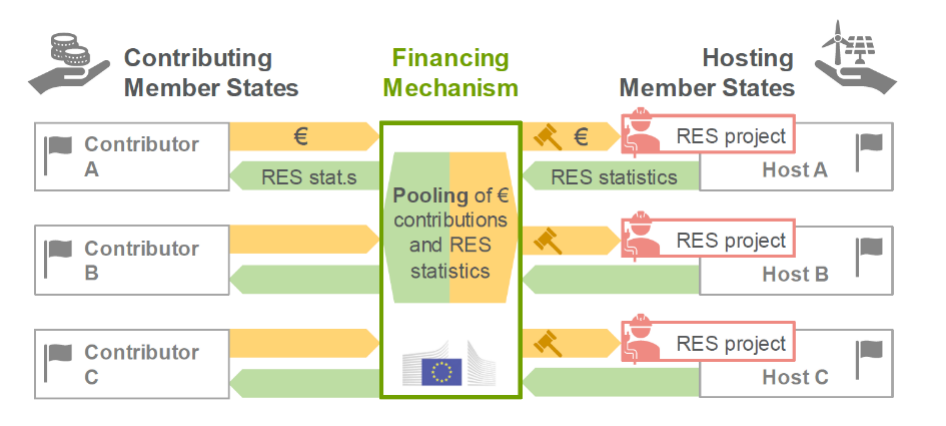
Under the REFM, the European Commission determines support levels and allocates renewable energy grants on a case-by-case basis. The projects should be located in the EU country expressing its interest to provide its territory for the physical installation of a renewable energy plant. For this, the European Commission involves another (other) EU country (countries) that would like to make financial contributions to such projects to increase renewable energy statistics.
Table 1 describes the scheme of the REFM.
Table 1. Scheme of the REFM
Source: http://aures2project.eu/wp-content/uploads/2020/11/AURES_II_D6_3_EU.pdf
Main parties of the REFM
According to the Regulation, the REFM involves the following main parties:
(1) “Contributing Member State”, a member state that makes a direct payment into the REFM;
(2) “Host Member State”, a member state that allows physical installations for the production of renewable energy to be installed on its territory; and
(3) “the European Commission” (the “Commission”), which is in charge of organising grant award procedures, including calling on the EU countries to express their interest in participating as Contributing and/or Host Member State in grant award procedures organised by the REFM and shares with the EU countries an indicative calendar covering the procedural steps from the expression of interest to the calls for proposal, as well as an indication of when the Commission intends to organise the next call for expressions of interest.
In addition, the Regulation prescribes that the renewable energy produced by projects supported by the REFM must generate statistical benefits for the Contributing Member States, which means that the Contributing Member States receive the benefit of the renewable energy statistics from the projects to which they contributed (data on generated renewable energy is transferred from the Host Member State to the Contributing Member State), increasing their own national renewable energy shares.
The amount of the renewable energy generated by projects supported by the REFM will be statistically allocated and distributed as follows:
i. 80% to the Contributing Member States;
ii. 20% to the Host Member States.
However, the Commission may propose to deviate from these distribution percentages and to allocate the energy within a range from 50% to 100% for the Contributing Member State, and from 0% to 50% for the Host Member State, while in sum it will equal 100%.
The REFM grants many benefits for the involved parties: the Contributing Member States can save costs by financing the renewable energy projects of other countries, which are more profitable or feasible than in their own countries (access to different natural conditions including sea, mountains or just using the open areas of other countries), and by obtaining the Commission’s lower interest rates, and, at the same time, receive renewable energy points for its statistics. In turn, the Host Member States have the possibility to attract new investments to their renewable energy projects, which also means new working places, taxes and fees, as well as environmental benefits.
Grant award procedure
Chart 1 “Grant award procedure” below describes the main steps the parties must follow to be awarded grants.
Chart 1 “Grant award procedure”
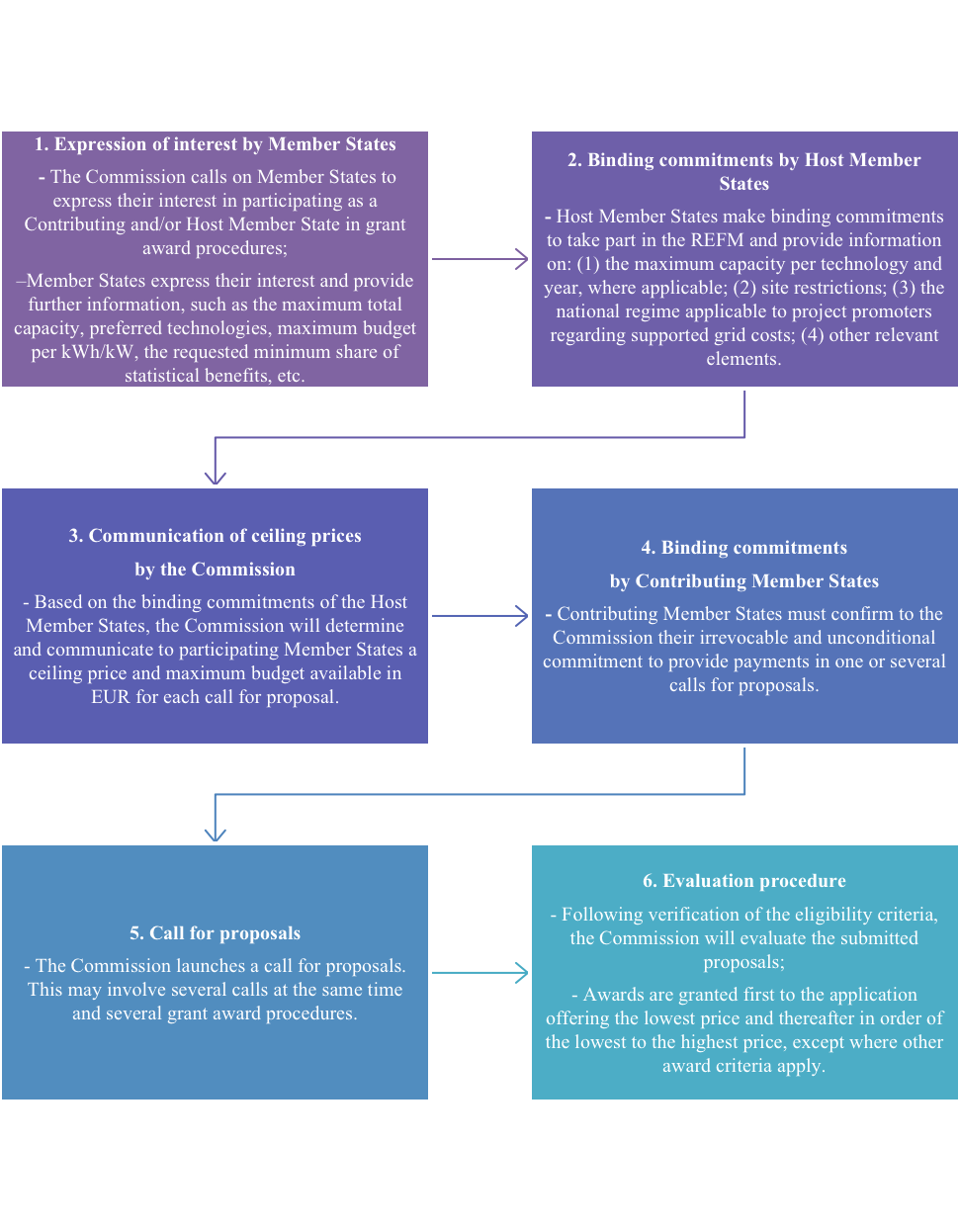
Consequently, the Commission informs participating bidders of the grant results and prepares and signs agreements with the winners.
In addition, the Regulation provides that third (non-EU) countries can also participate in the REFM. However, for this, among others, the following conditions must be in place: (1) an agreement between the EU and that third country on the mutual recognition of guarantees of origin; (2) the direct import or export of energy.
The actual implementation of the REFM grants award procedure is yet to come and will depend on the interest of EU countries and on the indicative calendar developed by the Commission.
However, the introduction of the REFM demonstrates once again that EU is betting on the development of renewable energy and cross-EU cooperation. Theoretically, Ukraine could also be involved in the REFM as a third country if all criteria are met, including the implementation of the mutual recognition of guarantees of origin between the EU and Ukraine. We will monitor developments in the REFM and, when the first projects are implemented under the REFM grants, we will be able to draw certain conclusions and forecasts regarding the future of the REFM grants award procedure.
